
Reviewed · MEXICO CITY LGBTQ TOURS
Gay Side of History through Plazas & Temples
Mexico City’s old center is more than a backdrop on this walk. It is the subject: temples, churches, government buildings, and plazas become clues to the city’s LGBTQ+ past, from the Mexica era through Spanish rule and into more recent history. The tour connects those stories to Mexico’s wider history, so you leave with more than a list of landmarks.
I like two things in particular: the small group of no more than 10 leaves room for questions, and the route pairs major sights with less familiar stories, including the scribes at Santo Domingo and the history of the Inquisition. Coffee or tea, water, a digital map, and a downloadable e-book add practical value.
One consideration: this is a history-heavy walk, not a quick photo stop at the main sights. It lasts about three and a half hours, and the guide’s storytelling is a large part of the experience. If you want a brisk tour with little discussion, this may not be your match.
- Begin above the ruins: Start at Librería Porrúa, where a rooftop balcony looks toward Templo Mayor and the Palace of the Royal Duty.
- Read familiar landmarks differently: The Cathedral, Zócalo, and National Palace sit within a wider account of Mexican and LGBTQ+ history.
- Make time for Santo Domingo: Scribes still work beneath the plaza’s Portal de Evangelistas, near buildings tied to the Spanish Inquisition.
- Keep the group small: A maximum of 10 people makes it easier to ask questions and follow the guide’s historical thread.
- Take the material with you: The digital Historic Center map and RAINBOW MEXICO e-book offer resources beyond the walk.
Start with coffee above Templo Mayor
The tour starts at Librería Porrúa, at República de Argentina 15, in the Historic Center. The opening hour is spent on a rooftop balcony with views toward the Palace of the Royal Duty, the former hideaway rooms of Frida Kahlo, and the ruins of the Great Aztec Temple, known as Templo Mayor. Coffee or tea is included, a thoughtful way to settle in before the walk begins.
That view gives the guide a natural place to set the scene. Carlos, the guide most often associated with the experience, is praised for building a broad historical account, from the first peoples of the Americas through the Spanish conquest and later eras. His style is described as lively and open to questions, not a lecture delivered at arm’s length. The subject is LGBTQ+ history, but the context reaches well beyond it.
That broader frame matters. A story about sexuality in Mexico City cannot be separated neatly from the history of Indigenous societies, conquest, Catholic rule, and changing political power. The guide can use the sights in front of you to make those connections concrete. For history lovers, this opening is a strong reason to choose the tour over a basic landmark walk.
The trade-off is that you spend a substantial part of the experience listening and looking from one spot. If you are eager to get moving straight away, an hour at the opening stop may feel long. If you like to understand what you are seeing before stepping into the streets, it is time well spent.
Templo Mayor and the Cathedral: two worlds in one square
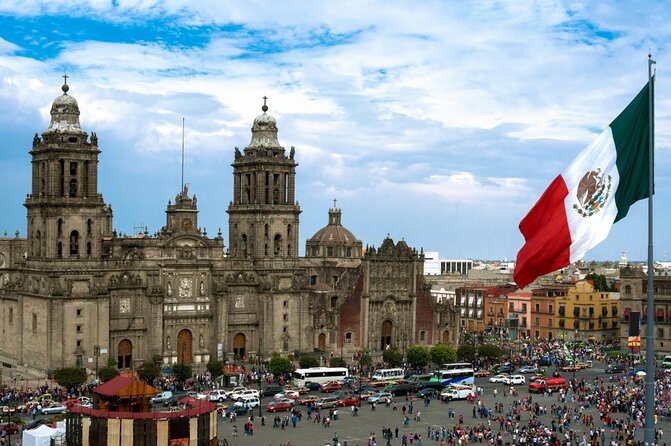
From Porrúa, the route takes in Templo Mayor, the principal temple of the Mexica in their capital, and the Metropolitan Cathedral. Their proximity makes this one of the most striking parts of the Historic Center. The temple ruins point to the city’s pre-Hispanic past; the vast cathedral represents the Catholic order imposed after the Spanish conquest.
The tour’s purpose is not simply to name the buildings. It uses them to ask how ideas about gender, sexuality, religion, and authority have changed over time. You should expect the guide to link the physical remains and surviving institutions to wider social history, rather than treat LGBTQ+ stories as a separate footnote.
These are active, well-known sights, so the setting can feel busy and the walk does not promise a private visit or entry into every building. The stated stops focus on viewing and interpretation. That is useful to know if you expect an interior tour or a detailed archaeological visit. The emphasis here is on context and connections.
More LGBTQ tours around Mexico City:
- Mexico City: Queer Mexican History
★ 4.7 · 24 reviews - Mexico City: Gay Tales
★ 5.0 · 4 reviews - Discover Mexico City’s (CDMX) Gay (LGBTQ) Hotspots Guided Tour
★ 5.0 · 3 reviews
Zócalo: the city’s meeting place
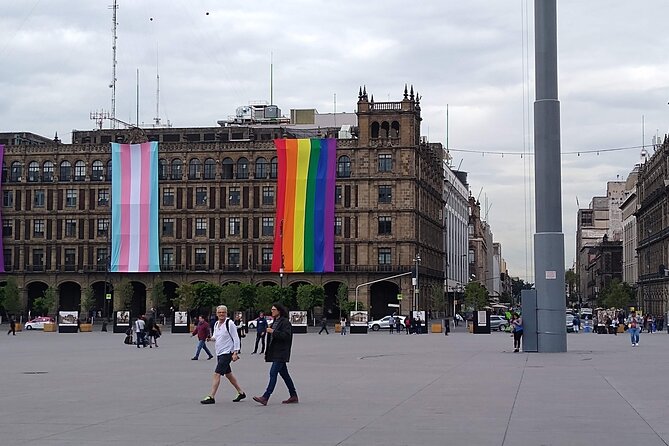
The next main stop is Zócalo, Mexico City’s central plaza and a gathering place since the 16th century. You have about 30 minutes here, with views of the National Palace, seat of the federal executive and, since 2018, the president’s official residence.
The square gives the guide a chance to explain how the city’s political heart took shape. Its scale also helps you see the layers of power that have occupied this center, from Mexica capital to colonial city and modern seat of government. The LGBTQ+ angle fits into that larger story of who held authority, who was judged by it, and how social rules shifted.
This is a good place to listen closely and take in the surrounding buildings, but it is not a stop built around a long independent visit. The tour includes no admission ticket at Zócalo, and its value comes from the guide’s interpretation. If you have more time afterward, the plaza is an easy place to revisit at your own pace.
Centro Cultural de España: a restored mansion behind the Cathedral
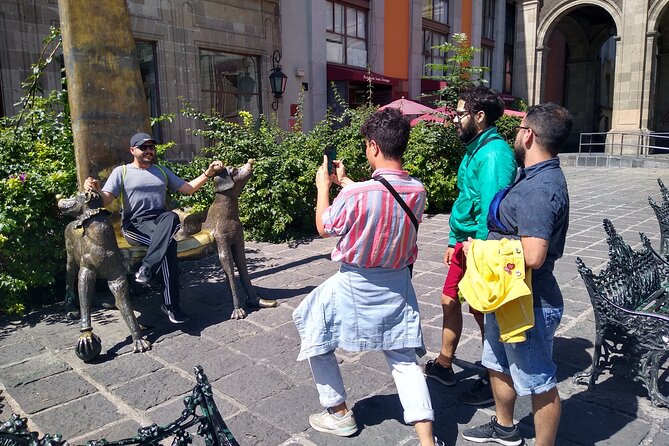
The route continues to the Centro Cultural de España, at 18 Guatemala Street, tucked behind the Cathedral. This former mansion had fallen into ruin before the Mexico City government transferred it to the Spanish government in the late 1990s. After restoration, the center opened in 2002, with the King of Spain and the President of Mexico attending its inauguration.
That story offers a useful change of scale. The tour moves from monumental civic spaces to a restored building with a more recent history of cultural cooperation and renewal. It also gives the guide room to connect Mexico’s colonial inheritance with how the Historic Center is used and cared for today.
The stop is listed as 30 minutes, with no admission ticket required. The focus is on the place and its story, rather than a guaranteed visit to a particular exhibition. If you are hoping to spend time inside the center’s galleries, check what is open separately and allow extra time after the tour.
Santo Domingo: scribes, printing, and a difficult past
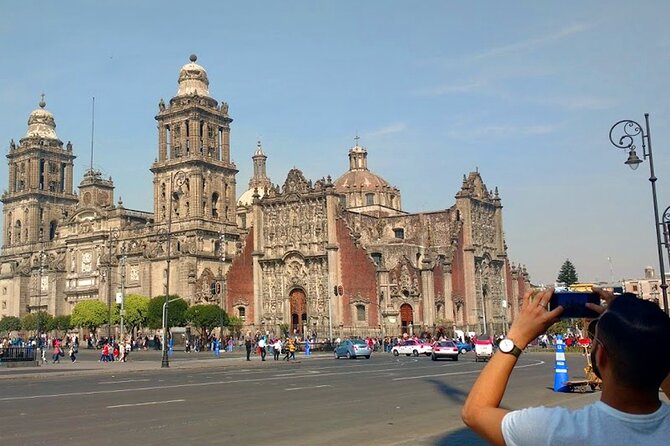
Plaza de Santo Domingo is the route’s final main stop, and it may be the most layered. Along the west side, the Portal de Evangelistas is a colonnade where scribes work with typewriters and older printing machines. It is an unusual sight in a city center filled with grand churches and government buildings, and it gives the plaza a working, everyday character.
The nearby Old Customs Building lies on the plaza’s east side. The Church of Santo Domingo faces the square from the north. Together, these buildings help the guide place the plaza in Mexico City’s religious and civic history. The church is also identified as the starting point of El Camino Real, the historic route from Old Mexico to New Mexico, and as a safe haven for gay male couples.
The tour also addresses the Spanish Inquisition, described as the civilian institution responsible for executing people convicted of homosexuality between 1521 and 1821. That is a serious subject, and it gives the walk a sobering edge. The guide’s role is important here: this material needs context, not a passing shock detail. Expect the discussion to include how institutions enforced social and religious rules, and how LGBTQ+ people navigated those forces.
The experience ends at the Antiguo Palacio de la Santa Inquisición, at República de Brasil 33, on the edge of Santo Domingo plaza near República de Venezuela and República de Brasil. The endpoint makes the final stretch especially relevant to the themes of the tour. It is a fitting close, though the subject matter is heavier than the opening views and coffee.
More history tours around Mexico City:
- Historic Downtown Walking Tour
★ 5.0 · 1,289 reviews - Historic Center Food Tour in Mexico City
★ 5.0 · 1,263 reviews - Mexico City: Historic Downtown Walking Tour
★ 4.8 · 1,039 reviews - Walking Tour of the Historic Center of Mexico City
★ 5.0 · 870 reviews
A guide-led walk, not a checklist tour
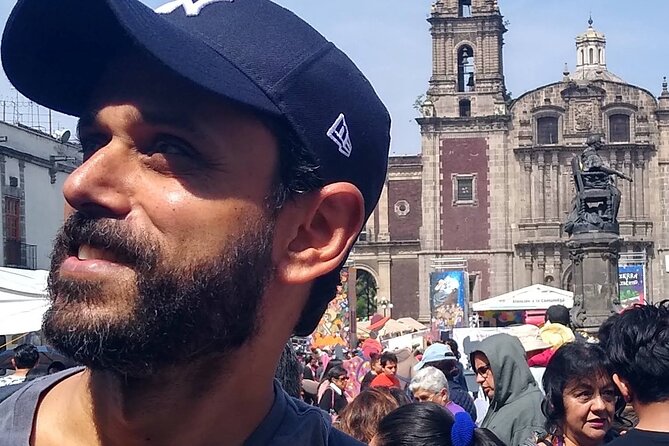
The route covers about one mile over roughly three hours of walking, with the full experience lasting around three and a half hours. That is a moderate pace on paper, but the time includes extended stops and discussion. You do not need to be a fast walker, though you should be comfortable spending several hours on your feet.
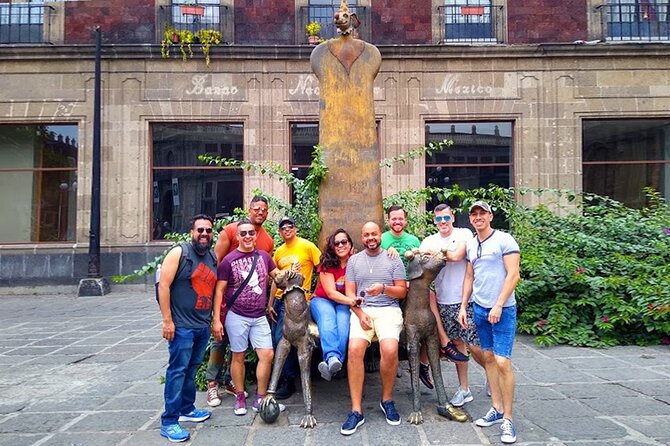
The group is capped at 10 people, which is a real advantage for this kind of subject. You can ask questions, and the guide can adjust the conversation to the group’s interests. Carlos is especially praised for asking about personal interests and weaving them into the tour. One couple who had visited Mexico City many times found that this approach led them to places they had not seen before.
Several accounts describe the walk as engaging even for people who already know Mexican history or are not LGBTQ+. That makes sense: the tour uses an LGBTQ+ perspective to add a new layer to familiar history, rather than limiting itself to a narrow set of topics. It can suit LGBTQ+ visitors, allies, and anyone who wants a more thoughtful introduction to the Historic Center.
What the $99 price includes
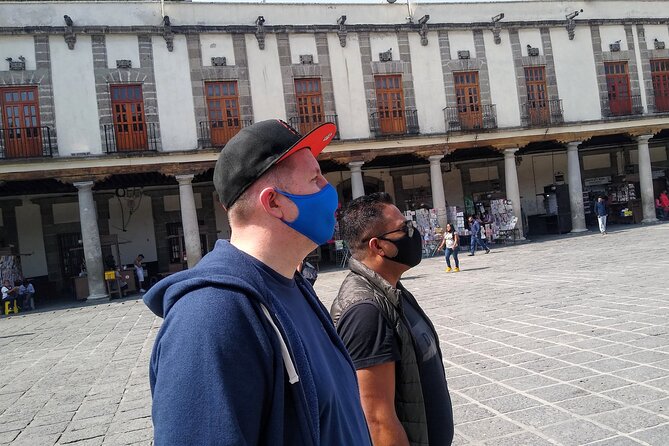
At $99 per person, this is more expensive than a simple free walking tour, so the value depends on what you want from the morning. You are paying for a small-group guide-led experience with a specialized subject, not just directions between landmarks. The included coffee or tea and bottled water are useful, but the bigger value is the guided historical interpretation.
You also receive a digital LGBTQ+ map of the Historic Center and extra resources, plus a downloadable PDF of the e-book RAINBOW MEXICO: Bridging Forgotten Pasts and Vibrant Futures. Those materials give you a way to revisit names and places after the walk, and may help you explore further on your own. They are especially useful if you want the tour to be a starting point rather than a standalone activity.
The tour is offered in English, requires a minimum age of 18, and operates in all weather, so dress for the forecast. It starts at 10:00 am. The meeting point and ending point are both in the Historic Center, but they are at different addresses, so plan for the walk to finish at Santo Domingo rather than return to Porrúa. The operator allows free cancellation up to 24 hours before the start time; later cancellations and changes are not accepted.
One practical caution: a recent booking was canceled an hour before the start, and the customer had trouble reaching the operator to confirm. That appears to be an exception rather than the usual experience, but it is a reminder to keep an eye on messages and confirm the tour is going ahead before setting out, especially if your schedule is tight.
Is this the right Mexico City walk for you?
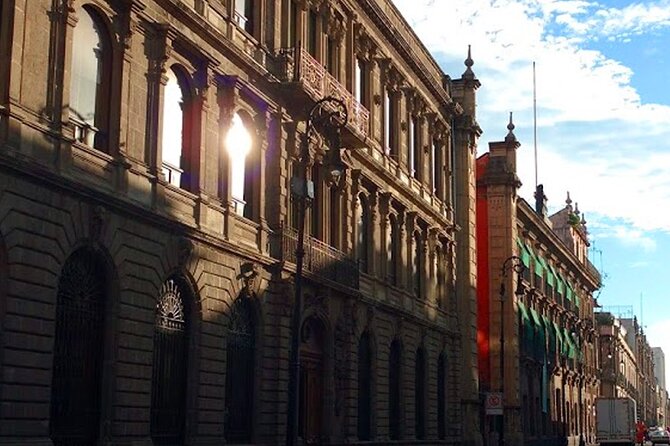
I would choose this tour if you want history with a clear point of view, enjoy asking questions, and are curious about how LGBTQ+ lives intersect with Mexico’s political and religious past. The small group, substantial guide time, and follow-up resources make it more useful than a quick pass by the main monuments. Carlos’s storytelling is a particular draw if he is leading your date.
I would look elsewhere if your priority is entering major buildings, covering a large area, or keeping the history light. The walk spends much of its time on explanation, and Santo Domingo’s Inquisition history can be difficult material. For the right person, that seriousness is part of the value. Book it as a compact history seminar on foot, with a city’s most familiar spaces opening onto stories you may not have heard before.
FAQ
How long is the tour?
It lasts about three and a half hours. The walk covers roughly one mile over about three hours, with time for stops and discussion.
What time does the tour start?
The stated start time is 10:00 am.
Where does the tour begin and end?
It starts at Librería Porrúa, República de Argentina 15, in the Historic Center. It ends at the Antiguo Palacio de la Santa Inquisición, República de Brasil 33, near Plaza de Santo Domingo.
How large is the group?
The maximum group size is 10 people.
What is included in the price?
The tour includes a local guide, coffee or tea, bottled water, a digital LGBTQ+ map of the Historic Center with extra resources, and a downloadable PDF of RAINBOW MEXICO: Bridging Forgotten Pasts and Vibrant Futures.
Is the tour offered in English, and is there an age limit?
Yes, it is offered in English. The minimum age is 18.
Can I cancel for a refund?
You can cancel at least 24 hours before the tour’s start time for a full refund. Cancellations or changes made less than 24 hours before the start time are not accepted.
New on the list in Mexico City
- Private & Tailor Made Tour to Teotihuacan Pyramids!★ 5.0 · 37 reviews
- Private Tour: Pyramids of Teotihuacan and Piramides of Atlantes de Tula★ 5.0 · 26 reviews
- Xochimilco Tour★ 5.0 · 26 reviews
- Private tour to Queretaro and San Miguel de Allende★ 4.0 · 10 reviews
- Private Street Food & Mural Art Tour in Mexico City★ 3.5 · 3 reviews
- Private tour Antropology Museum Frida Khalo museum and Leon Trotskyi museum★ 5.0 · 3 reviews
- Private Tour: Museum of Anthropology and Chapultepec Castle★ 5.0 · 3 reviews
- Ticket to Frida Kahlo Museum (Blue House)★ 5.0 · 3 reviews
Mexico City LGBTQ Tours, compared.

Discover Mexico City’s (CDMX) Gay (LGBTQ) Hotspots Guided Tour
Read our review →Browse the lists this tour appears in